
astrology
which zodiac sun signs get along with others?
1 min read →
13 Major Doshas in Indian Astrology: Meaning, Causes, Remedies & How to Identify Them.
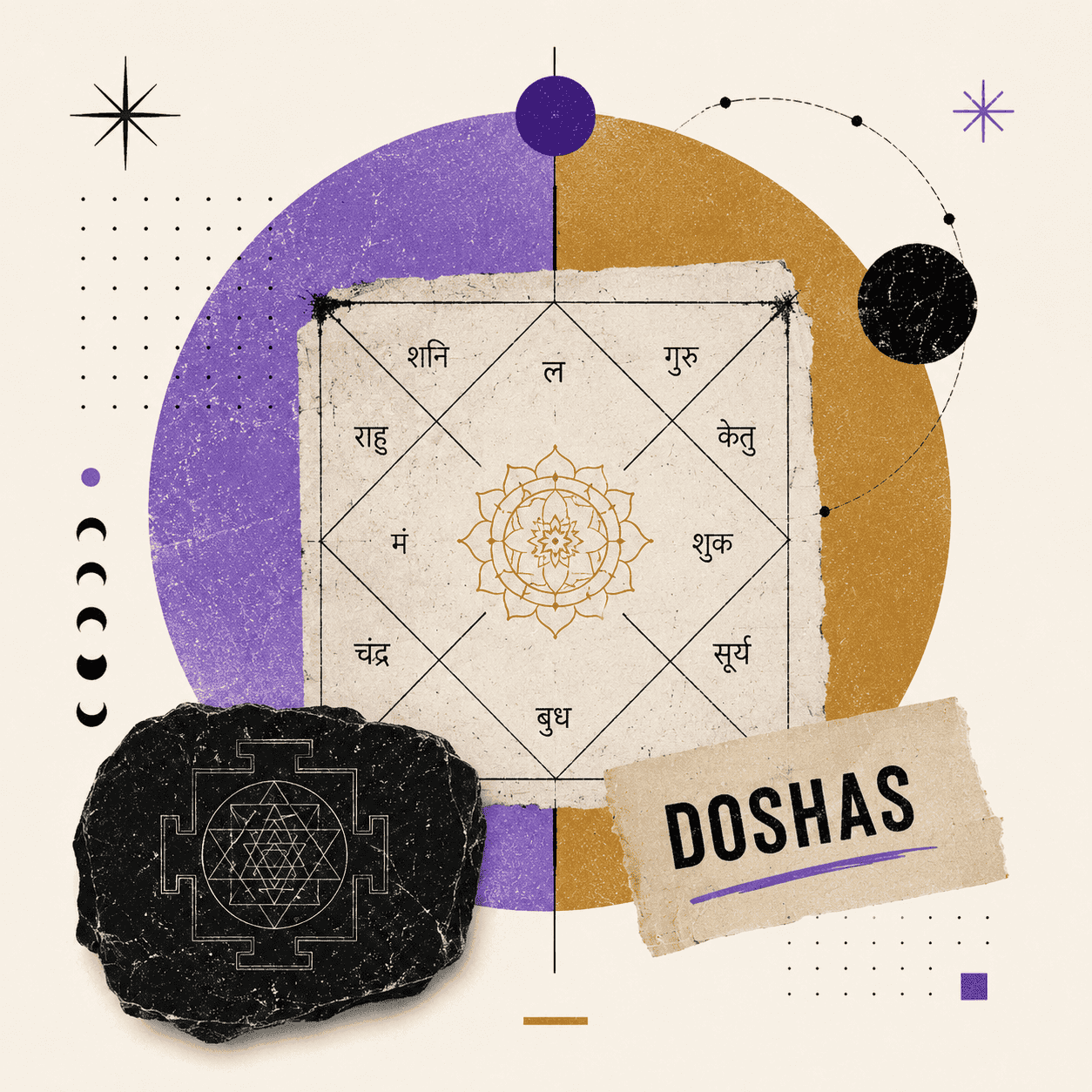
Indian astrology uses the word dosha to describe a planetary affliction, imbalance, or fault pattern in a birth chart. A dosha is believed to show where life may face friction, delay, stress, or repeated obstacles, depending on which planet, house, or combination is involved.
The meaning of dosha can differ slightly across traditions. In classical Vedic astrology, dosha usually refers to an unfavorable placement, conjunction, aspect, or house relationship. In KP astrology, the focus is more event-based, so astrologers often ask whether the chart truly promises the result rather than just labeling a dosha. North Indian and South Indian charts use different visual formats, but the underlying planetary logic remains the same.
A dosha is not simply a “bad” placement. It is a pattern that may create pressure in a specific area of life such as marriage, health, wealth, children, family harmony, or career.
Astrologers usually study:
This is why two people may have the same dosha name in their chart, yet the results can differ greatly.
In Vedic astrology, a dosha is generally formed by malefic influence, such as:
KP astrology does not rely only on the dosha label. It checks whether the event will actually manifest through:
So in KP, a dosha may be present technically, but its effect may be weak, delayed, or cancelled by the chart’s actual promise.
The chart format differs, but the astrological content is the same. The main difference is in reading style:
In both, the final conclusion depends on the strength of the affliction and the rest of the horoscope.
Below are 13 widely discussed doshas in modern Indian astrology practice. Different schools may classify them slightly differently, but these are among the most popular and commonly searched.
Mangal Dosha, also called Kuja Dosha, is formed when Mars occupies sensitive houses such as the 1st, 2nd, 4th, 7th, 8th, or 12th, or strongly afflicts marriage-related houses.
It is often linked with delay in marriage, conflict in relationships, impatience, and domestic tension.
Common remedies:
Kaal Sarp Dosha is said to occur when all the planets are placed between Rahu and Ketu.
It is associated with repeated delays, sudden obstacles, mental pressure, and a sense of being blocked despite effort.
Common remedies:
Pitru Dosha is associated with ancestral imbalance or unresolved family karma. It is often read through afflictions involving the Sun, Rahu, Saturn, or the 9th house.
It may show as family obstacles, inheritance issues, recurring blockages, or difficulties connected to lineage.
Common remedies:
Nadi Dosha is mainly used in marriage compatibility. It forms when both partners have the same Nadi in Ashtakoota matching.
It is traditionally believed to affect marital compatibility and progeny-related matters.
Common remedies:
Grahan Dosha forms when the Sun or Moon is conjunct Rahu or Ketu.
It is associated with emotional turbulence, confusion, stress, and sudden disruptions.
Common remedies:
Shani Dosha is a broad term for Saturn affliction, including Sade Sati and Dhaiya.
It often brings delay, pressure, discipline, and life lessons that require patience and consistency.
Common remedies:
Guru Chandal Dosha is usually formed when Jupiter is conjunct Rahu or Ketu.
It can create confusion in judgment, ethical instability, weak guidance, or problems related to education and wisdom.
Common remedies:
Angarak Dosha is typically associated with Mars and Rahu together or in strong affliction.
It is linked with aggression, impulsiveness, conflict, accidents, and heated reactions.
Common remedies:
Shrapit Dosha is commonly read as an affliction involving Saturn and Rahu.
It is often treated as a karmic burden that creates chronic delay, frustration, or repeated struggle.
Common remedies:
Kemadruma Dosha is usually related to an isolated Moon, especially when the Moon lacks supportive planets around it.
It is often connected with loneliness, emotional insecurity, and financial instability.
Common remedies:
Vish Yoga is generally linked to the affliction of the Moon by Saturn.
It is seen as a difficult emotional combination that can create heaviness, stress, and mental strain.
Common remedies:
Daridra Dosha is associated with combinations that indicate poverty, lack of retention, or repeated scarcity.
It is usually read through affliction to wealth houses, Jupiter, Venus, or the Moon.
Common remedies:
Bhakoot and Gana doshas are also used in marriage matching. Bhakoot relates to emotional and practical compatibility, while Gana relates to temperament and personality alignment.
These are not always treated as severe in isolation, but they matter when combined with other matching issues.
Common remedies:
In astrology, remedies are usually customized based on the chart, but common categories include:
A strong remedy system should not rely on one fix for every chart. The same dosha can behave differently depending on planet strength, divisional charts, timing, and cancellation conditions.
Kundali Shuddhi can help users identify doshas using AI astrology insights combined with trusted knowledge guidance. Once the dosha is identified, users can be guided toward practical solutions such as yantras, rudrakshas, gemstones, crystals, and online puja services.
This makes the process easier for users who want both chart analysis and remedial action in one place.
Doshas are best understood as chart patterns that point to specific life challenges, not as permanent fate. With the right interpretation, many doshas can be understood clearly and managed through suitable remedies.
If you want to know which doshas are present in your kundali and what remedies may suit your chart, Kundali Shuddhi can help you explore AI-powered analysis with trusted astrological guidance.
Check your doshas with Kundali Shuddhi and get personalized guidance on yantras, rudraksha, gems, crystals, and online puja services designed to support your chart.
Subscribe to our newsletter for cosmic drops.
READY FOR PERSONALIZED INSIGHTS
START A READING →